

Scott Adams, creator of Dilbert, died on January 13, 2026, at age 68.
If you only knew him for the comic strip, you missed his real genius. Adams was one of the sharpest observers of systems, persuasion, and "talent stacking". His book "How to Fail at Almost Everything and Still Win Big" became a cult classic in entrepreneurship circles because it was ruthlessly practical.
I became a fan of Adams leading into the 2016 election. While everyone else was writing off Trump's chances, Adams was predicting a win way before anyone else took it seriously. I was fascinated by his approach to thinking about the problem and the connections he was making between persuasion, branding, and voter psychology.
He saw what others were completely blindsided by.
I used that edge to make a bet on the 2016 election. I won the bet and bought bitcoin with the proceeds. That bitcoin purchase has been extremely profitable.
Adams also had underappreciated financial wisdom that aligns perfectly with the FIRE mindset. This week, we're diving into his best ideas and where I respectfully part ways with him.
⚙️ Systems vs. Goals
Adams' most influential idea:
"Losers have goals. Winners have systems."
This one sentence has done a lot to change how I think about my personal finances and career.
A goal is a specific outcome you either hit or miss. A system is something you do regularly with reasonable expectation that it improves your odds over time.
In the FIRE approach, we set a goal to reach financial independence, but the system is what really matters.
Adams explained: "Goal-oriented people exist in a state of continuous pre-success failure at best, and permanent failure at worst if things never work out. Systems people succeed every time they apply their systems."
Think about that. If your goal is to hit $1 million in savings, you're "failing" every single day until you hit that number. Even at $999,000, you haven't achieved the goal. You're living in a perpetual state of not-there-yet.
But if your system is to automatically save 50% of every paycheck and stack sats weekly, you succeed every time you execute the system. The outcome takes care of itself.
This is the ultimate FIRE mindset.
Your DCA is a system. Your automatic savings is a system. Your side hustle is a system. Hitting a specific FIRE number is the goal that the system is designed to achieve.
Goals are useful for direction, but systems are what get you there. Focus on the system, and the number will materialize as a natural consequence.
Adams also understood that willpower is finite: "Willpower is a finite resource. Don't pick a model that has failure built into it."
You can't white-knuckle your way through 10-15 years of accumulation. You need systems that run on autopilot, that remove the need for constant decision-making. Set it up once, let it compound, and get out of your own way.
🧱 Talent Stacking
For me, Adams' second major insight is that you don't need to be world-class at one thing. You just need to be "pretty good" (top 25%) at multiple complementary skills.
His said as much: "I'm a perfect example of the power of leveraging multiple mediocre skills. I'm a rich and famous cartoonist who doesn't draw well."
Adams wasn't the best artist, writer, comedian, or businessman. But combining all four created Dilbert and made him a multimillionaire.
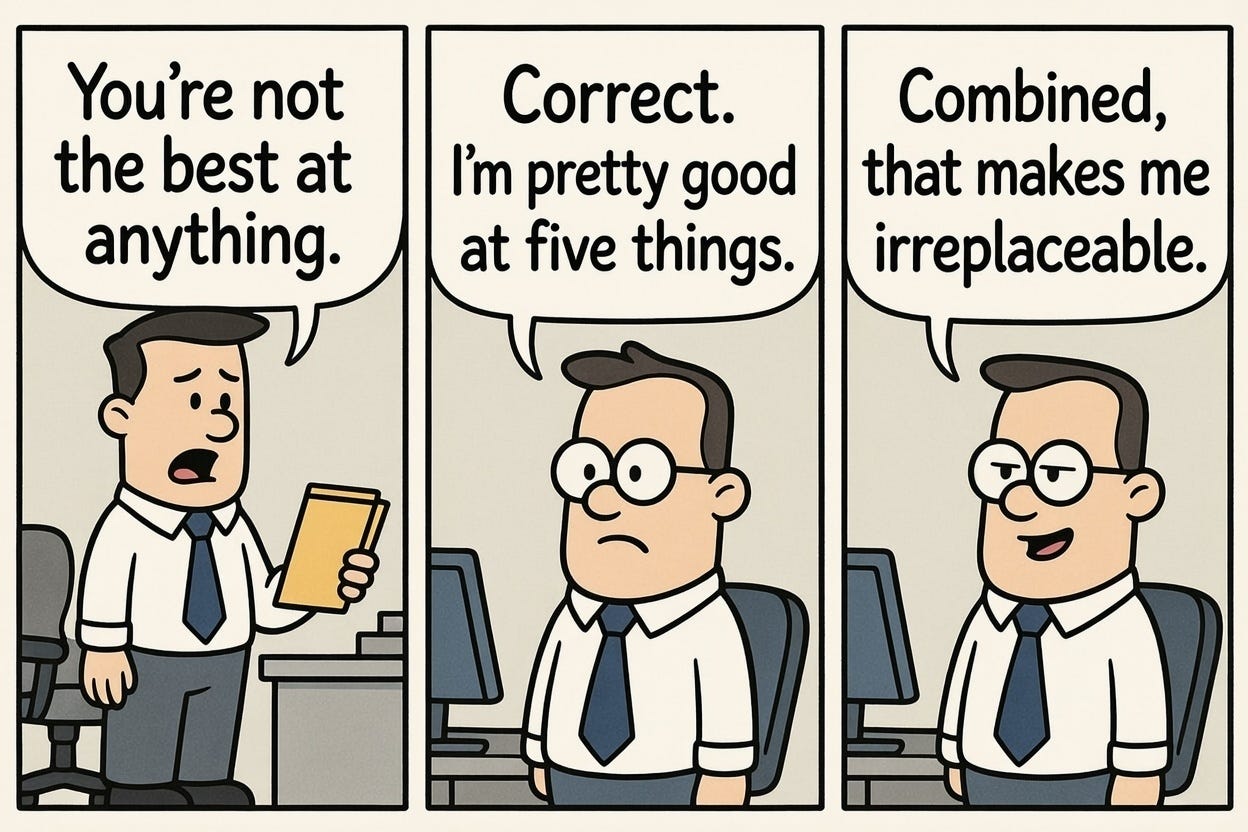
The FIRE application is obvious: You don't need an exceptional income OR exceptional savings discipline. Being pretty good at both compounds powerfully.
Multiple income streams beat a single salary. Combining skills—like coding + finance + writing—creates unique career moats that are hard to replicate.
Adams' talent stack philosophy is also why side hustles and freelancing work so well for FIRE practitioners. You're not trying to be the world's best developer or the world's best writer. You're building a portfolio of complementary skills that stack into something valuable and rare.
🔀 Where We Part Ways
Adams was brilliant, but, of course, there are places where his thoughts on personal finance and mine diverge. Here's where I respectfully disagree.
